Deformations on the Flat Universe, 2009 is an audiovisual installation using rear projection, fabric sheets, a metal grid and controlled ventilation. The work projects footage, downloaded from YouTube, onto unstable surfaces. The rear‑projected image, filtered through a garden fence and cast onto dust‑covered sheets, ripples with the airflow generated by a fan, causing image and material to deform continuously.
The footage shows the collapse of the Twin Towers on September 11, 2001, filmed from nearby buildings and revealing an intimate and immediate view of the smoke spreading across the urban grid of Manhattan. The installation features a soundtrack remixed by the artist from Vangelis’s Blade Runner score, reversed and slowed down. First presented in the basement of St Martin’s Byam Shaw during the 2009 Fine Arts Degree Show in London.
“Everything solid eventually melts into the air.”
Karl Marx and Friedrich Engels, The Communist Manifesto


Elements of modernist architecture with representations of the human body.
[Document 5.9 New Architecture and New Man]
“Rehabilitating the urban body”
A theoretical discussion on the relationship between the built environment and human experience.
The text mentions the “rationalization movement” of the interwar years (the period between World War I and World War II). This movement was not only motivated by financial or capitalist issues, but also by a “spirit of the age” that sought profound cultural and social renewal.
“New Architecture” refers to Modernism (Bauhaus style, Le Corbusier), which prioritized functionality, hygiene, and efficiency. “New Man” refers to the idea that a rational, clean, and well-planned environment would shape a healthier, more productive, and evolved citizen.
The grid overlaying the image symbolizes order, urban planning, and the “rationalization” mentioned in the text. It “encloses” or defines the space where bodies move.
The human figures (which appear to be anatomical studies or sketches) The classics represent the “urban body” being rehabilitated. The curved position may suggest both vulnerability and adaptation to the new rigor of the architectural forms in the background.
In the background, we see rectilinear structures, typical of modernist collective housing (such as housing units), which aimed to solve housing crises through standardization.
The final section cites the Institute for Social Science Research in Cologne, indicating that these ideas of “rehabilitation” of the body and society through design were grounded in sociological studies from the turn of the 20th century (citing authors such as Böttcher and Heimann).
The image is a critique or reflection on how modern architecture attempted to “organize” human life, treating the city and the body as machines that needed technical adjustments to achieve social perfection.
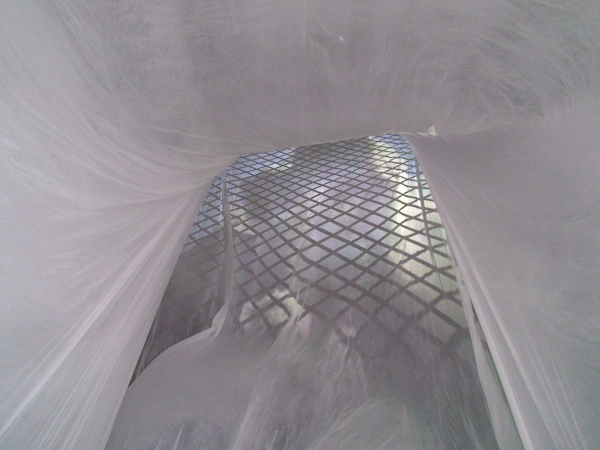
Deformations on the Flat Universe, 2009 é uma instalação audiovisual com projeção traseira, lençóis de tecido, grade metálica e ventilação. A obra projeta um vídeo, baixado do YouTube, sobre superfícies instáveis. A imagem traseira, filtrada pela grade de jardim e lançada sobre lençóis cobertos de poeira, ondula com o fluxo de ar produzido por um ventilador, fazendo com que imagem e matéria se deformem continuamente.
O vídeo mostra o colapso das Torres Gêmeas em 11 de setembro de 2001, registrado de edifícios vizinhos, revelando uma perspectiva íntima e imediata da fumaça se espalhando pela malha urbana de Manhattan. A instalação apresenta uma trilha sonora remixada pelo artista a partir da composição de Vangelis para Blade Runner, invertida e desacelerada. Apresentada pela primeira vez no subsolo da St Martin’s Byam Shaw durante o Degree Show de Belas Artes de 2009, em Londres.
“Everything solid eventually melts into the air.” Karl Marx e Friedrich Engels, Manifesto Comunista
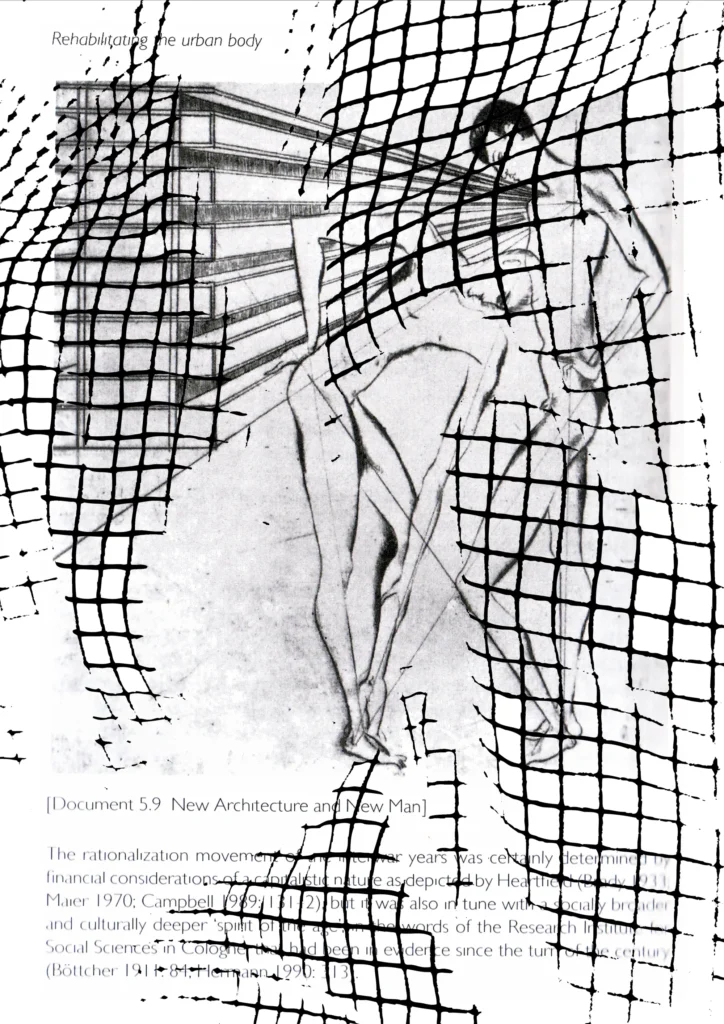
Elementos da arquitetura modernista com a representação do corpo humano.
[Document 5.9 New Architecture and New Man]”
“Rehabilitating the urban body”
Uma discussão teórica sobre a relação entre o ambiente construído e a experiência humana.
O texto menciona o “movimento de racionalização” dos anos entre guerras (período entre a 1ª e a 2ª Guerra Mundial). Esse movimento não foi apenas motivado por questões financeiras ou capitalistas, mas também por um “espírito da época” (spirit of the age) que buscava uma renovação cultural e social profunda.
A “Nova Arquitetura” refere-se ao Modernismo (estilo Bauhaus, Le Corbusier), que priorizava a funcionalidade, a higiene e a eficiência. O “Novo Homem” e a ideia de que um ambiente racional, limpo e bem planejado moldaria um cidadão mais saudável, produtivo e evoluído.
A malha que sobrepõe a imagem simboliza a ordem, o planejamento urbano e a “racionalização” mencionada no texto. Ela “prende” ou define o espaço onde os corpos se movem.
As figuras humanas (que parecem ser estudos anatômicos ou esboços clássicos) representam o “corpo urbano” sendo reabilitado. A posição curvada pode sugerir tanto a vulnerabilidade quanto a adaptação ao novo rigor das formas arquitetônicas ao fundo.
Ao fundo, vemos estruturas retilíneas, típicas de habitações coletivas modernistas (como as unidades de habitação), que visavam resolver crises de moradia através da padronização.
O trecho final cita o Instituto de Pesquisa em Ciências Sociais de Colônia, indicando que essas ideias de “reabilitação” do corpo e da sociedade através do design eram fundamentadas em estudos sociológicos da virada do século XX (citando autores como Böttcher e Heimann).
A imagem é uma crítica ou reflexão sobre como a arquitetura moderna tentou “organizar” a vida humana, tratando a cidade e o corpo como máquinas que precisavam de ajustes técnicos para atingir a perfeição social.
Deixe um comentário