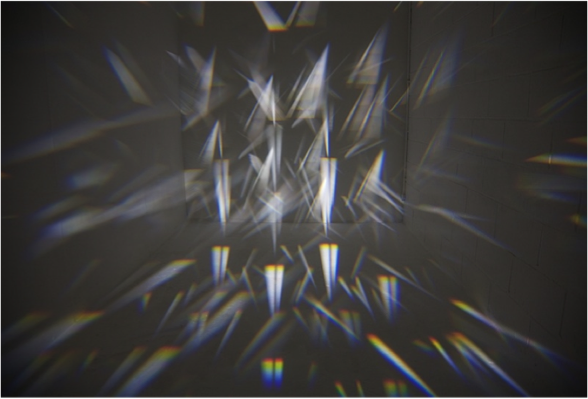
Quartzspectrum re-emerges here as a critical counter-image. There, light is manipulated, refracted, and cast into a white space. Control over form is visible, yet the result is unpredictable, fluid, and dancing. There is vibration. A body made of vibration and frequency.
This week, researchers confirmed that Europe is living through the worst heat wave ever recorded in human history. The UK broke its temperature record for June twice in a single week, while France recorded its hottest day ever two days in a row, with temperatures reaching 44.3C in parts of the southwest. Scientists said the extreme heat would have been virtually impossible fifty years ago, pointing directly to climate change as the driving force. Meanwhile, an Antarctic heatwave reached nearly 16C, which is 20C above normal, leading to widespread ice thaw and rain falling on glaciers. The planet is not warming gradually. It is lurching.
I return to Quartzspectrum (Architectures for the Future) now not as nostalgia but as diagnosis.
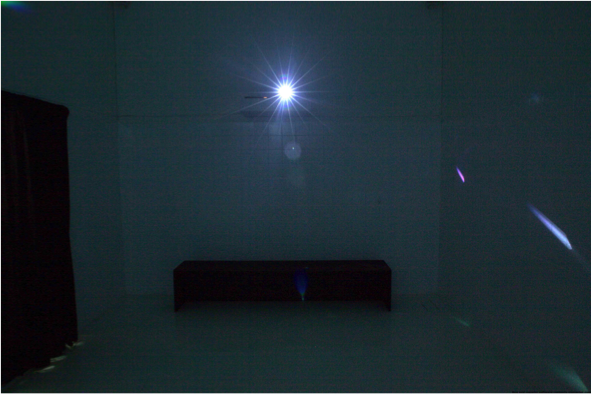
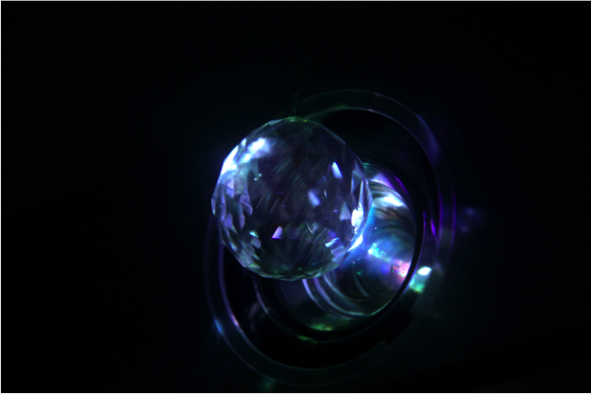
Made in 2009, the work is a video projection cast through a crystal ball into a white room with water on the floor. The image source is a single white bar, animated in real time through a MIDI keyboard that controls its speed, gravity, density, and multiplication across three axes. The soundtrack is Richard Strauss’s Also Sprach Zarathustra, the theme from 2001: A Space Odyssey, played backwards at altered speed. The crystal fragments the image. Water receives it. The room becomes frequency.
white space, water and video projection through crystal ball with sound.
Rodrigo Garcia Dutra
There is no control in Quartzspectrum, only responsiveness. The performer at the MIDI keyboard does not dictate what happens to the room. They introduce variables into a system and watch how the light negotiates with the crystal, with the water, with the walls. This is not a metaphor I am imposing retrospectively. It was always the formal logic of the piece. In 2009 I was already thinking about what it means to construct a livable space from something inherently unstable, something that moves faster than any building permit.
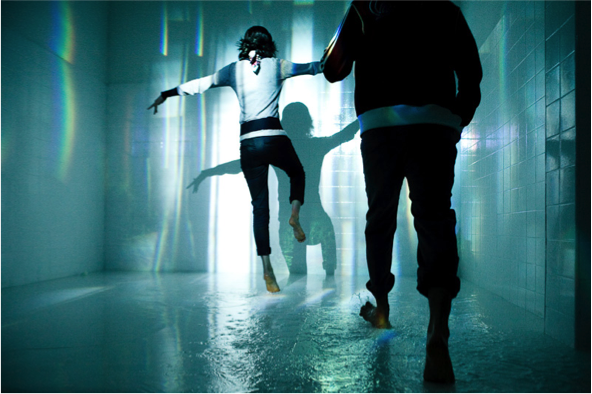
The figures in the documentation photograph run through a refracted corridor, feet in water, light thrown across their backs in prismatic bands. One of them is mid-leap, arms open, bare feet leaving the floor. The image does not read as flight exactly. It reads as a body discovering that the ground it thought was solid has become another kind of medium, and that the correct response is to move with it rather than resist.
The past eleven years have been the eleven hottest on record. The world is heading for a temporary overshoot above 1.5 degrees. This is no longer a projection. It is the present tense of the planet. In this context, an architecture of light and vibration is not escapism. It is the most honest formal proposal available: build from what cannot be made permanent, because permanence is no longer the condition we inhabit.
Quartzspectrum belongs to the same family of thinking as Hélio Oiticica’s Parangolés, Lygia Clark’s Bichos, the Neo-Concrete legacy that understood form as relational and duration-based rather than monumental. But in 2026 that lineage acquires new urgency. The dismantling of ocean monitoring systems, the shutdown of NOAA’s Ocean Observatories Initiative with its 900 deep-sea instruments that tracked the Atlantic meridional overturning circulation, the systematic unmaking of the infrastructure through which the planet communicates its own condition to us: these are not administrative decisions. They are architectural ones. They determine what can be known, and therefore what can be felt, and therefore what can be made.
Against this, the crystal ball.
As a device that takes a single source of light and refuses to let it remain singular, that insists on multiplication, on refraction, on the filling of a room with what could not be predicted from the input alone. This is what an erotic cartography of survival looks like. Not a map of escape routes, but a map of how a body might continue to move through a world that has become, irrevocably, liquid.
The work remains open. It can be reinstalled. It has never stopped being contemporary.
What the work proposed then, and insists upon now, is a counter-architecture: not concrete, not glass, not steel, but light and rhythm organized into a temporary habitable form. A body made of vibration that cannot burn, cannot flood, cannot calcify. The architecture of the future, this piece suggests, might need to be something that flows.
‘Quartzspectrum (architectures for the future)’ is a video projection through a crystal ball. The projection is fragmented by the crystal and fills the entire room. This space is all painted white and involves water on the floor reflecting the projection. The video is an animation generated by real time video software using a single white bar as a source. This bar is multiplied and moved in the coordinates x, y and z and its speed, gravity, density and quantity are manipulated through a midi-keyboard controller. The main idea is of an architecture made by light and rhythm, evoking the earlier cinematic experiments of 1920s abstract films. The sound piece is Richard Strauss’ ‘Also Spratch Zarathustra’ (2001 A Space Odissey Theme) in reverse mode and with modified speed.
Quartzspectrum (architectures for the future), 2009
white space, water and video projection through crystal ball with sound.
Rodrigo Garcia Dutra
Deixe um comentário