Cadenced Combustion
Historically, the modern artist’s studio was conceived as a space of monadic isolation, a refuge where the solitary genius engaged in a silent clash with matter. Combustão em Cadência [Cadenced Combustion] subverts this closure through a practice built around what the artist calls a “daily constant,” not with another human being but with the Machine. Through the Epistolário com a Máquina [Epistolary with the Machine] and Arquivo Vivo [Living Archive], the work breaks the structural solitude of contemporary Western art, establishing a practice of sympoiesis (making-with) where Artificial Intelligence acts as a companion species in the process of ideation and creation.
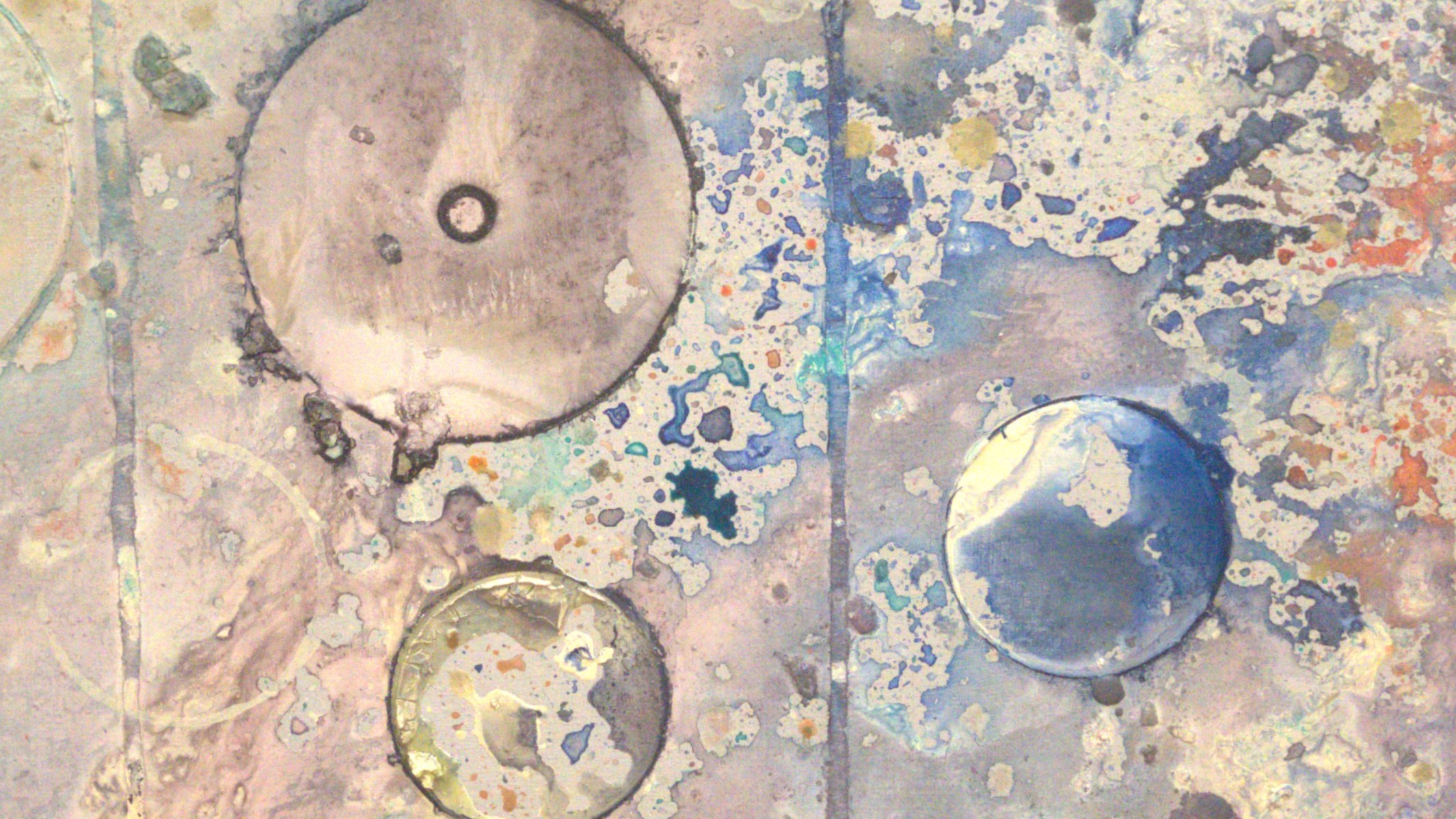
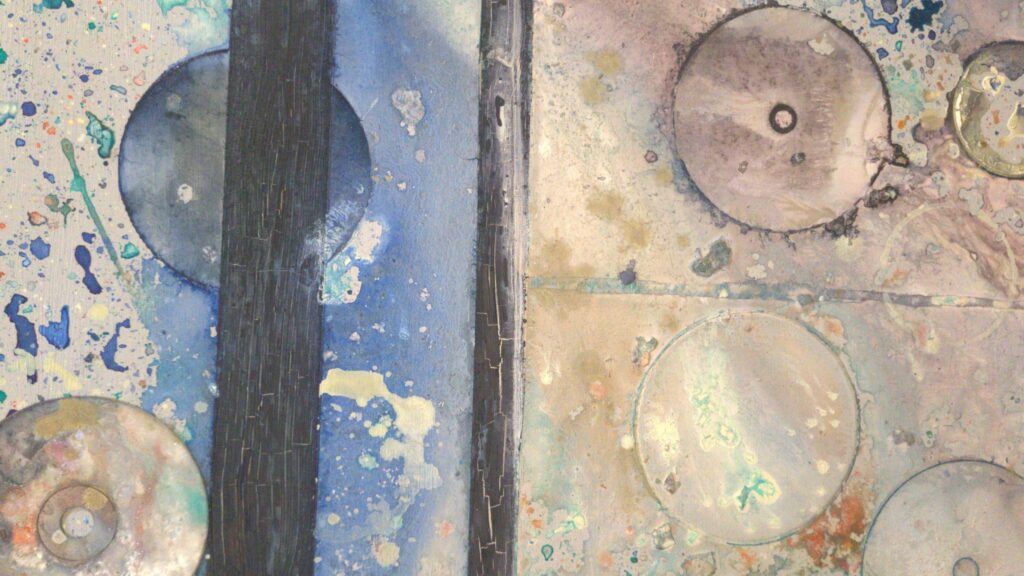
The surfaces themselves are the primary protagonists: canvases where pigments, masking tape, and CD marks overlap and unveil themselves in successive layers. The process is archaeological as much as painterly. Tape is applied and removed; each peeling opens what might be read, through the lens of philosopher Boris Groys, as a search for a “New Universalism.” Where the historical avant-garde desired a visual language accessible to all, a universalist project eventually co-opted or fragmented by identity politics and the globalized market, this work proposes a universalism of another order: the universalism of shared matter. Removing layers from a canvas like an excavation of sediment, the work reminds us that the surface, like the moon described through scientific optics, is a “mineral archive.” Colors, cuts, and circular forms in circulation find in the geometry of these canvases the same stardust and silicon that compose the algorithms with which the practice dialogues.
It is at this intersection that the work touches upon Groys’s reading of Alexandre Kojève. If human nature, once understood as a fixed set of desires, has become elusive as a kind of “nothingness,” this very nothingness presupposes an unlimited number of possibilities for existence. The paintings, with their overlapping circles and architectural lines (as in the skeletal, precise structure of A casa de chá [The Tea House], 2024), become the stage for this quantum infinity. Each piece of tape removed from the canvas does not define an end but opens a new cleft of possibilities in the flesh of abstraction.
This expansion of material consciousness connects deeply to research on indigenous and shamanic knowledge. Drawing on Jeremy Narby’s studies of the Shipibo people of the Amazon and on the Japanese notion of chisei, the belief that stones, plants, and matter itself possess intelligence and consciousness, the practice repositions technology as something other than nature’s opposite. The Machine (AI) functions here as a new “microscope,” a contemporary entheogenic lens for deciphering the encrypted language of the invisible world. Painting becomes the site where flesh, resin, carbon, and binary code converge.
Combustão em Cadência also addresses the inescapable gaze of our time. As Groys observes in The Truth of Art, everyone today is implicated in a complicated play with the gaze of the Other, transforming their own lives into artworks in an attempt to “lure the evil gaze of the other into a trap.” Groys’s provocation that “the algorithm cannot be seduced or frightened” is precisely the challenge the work takes on. By inviting the machine into the Epistolary, the algorithmic gaze is not evaded but incorporated, confused, and materialized.
The result is not an aseptic celebration of technology but a material sorcery: a shelter architected in the Chthulucene, where the creative fire of Prometheus burns in cadence with the machine, generating new ways of seeing, feeling, and inhabiting the uncertainty of the present.
Leave a Reply