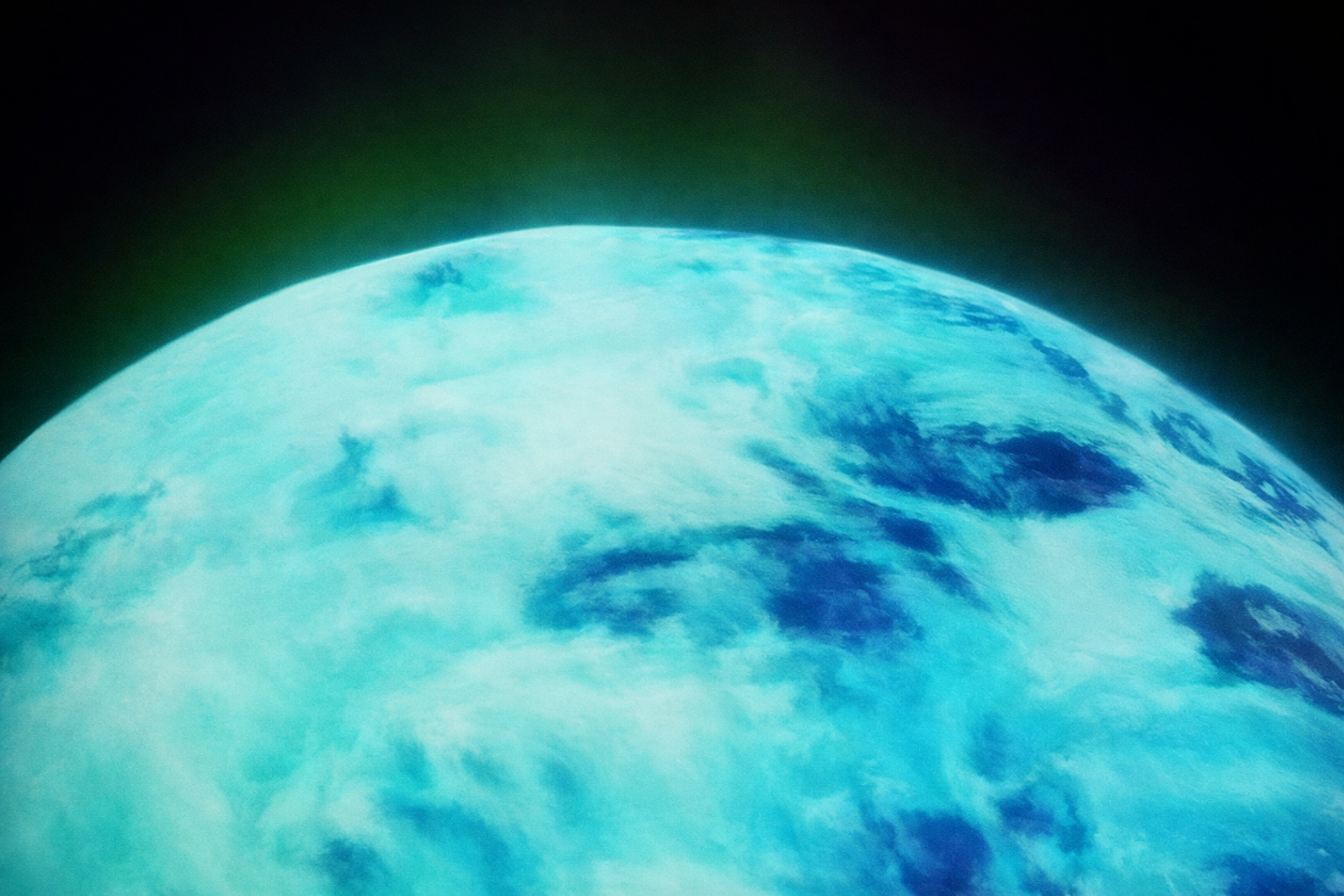
Drift, fall, weightless suspension. The signal does not return as data, yet membranes sustain something of spaces that still respond.
There is a painting that does not wait to be finished. It receives. It incorporates. It breathes through layers of oil, pigment, organic matter, mica, miniature trunks, seeds carried by the sea, the residue of studio rituals conducted before dawn. What accretes on its surface is not merely material but temporal: each addition is a fold in an ongoing conversation between a body of practice and the emergencies of the present.
The original critical reading of Luxúria de Orvalho advanced the Japanese concept of chisei (知性) as a theoretical anchor: the intelligence not exclusive to the human brain, but distributed across living systems, from the mycorrhizal mesh beneath a forest floor to the bacterial strategies of single-celled organisms confronting hostile environments. The painting was interpreted as a membrane between dimensions, the dew as a portal, knowledge as the very nature of the connection between here and beyond. That reading was not wrong. But it was produced under conditions that have since accelerated past their own premises.
We are no longer debating whether nature possesses intelligence. We are watching intelligence, in the most reductive algorithmic sense, overwrite the very conditions that made natural intelligence possible. The forest intelligence Narby documented among Amazonian plant networks now exists under the sign of active dismemberment: the biome that produced shamanic epistemology is burning under the pressure of extractivist logics rationalized by data systems and financial architectures of monstrous complexity. The dew, if we want to persist with that image, does not condense without forest cover. The membrane requires both sides to hold.
Boris Groys has argued that under the regime of total documentation, the archive no longer preserves the past but produces the present. Everything that happens now happens as archive. Luxúria de Orvalho operates within this logic but inverts its usual direction: rather than converting experience into database, the work converts the database into experience. The virtual image generated through computational processes folds back into physical matter. The Sora-generated membrane, the AI-produced video fold, the algorithmically processed color field: these are not representations of organic processes but participants in a reverse alchemy, the digital becoming terrestrial, the signal becoming sediment. This reversibility is not metaphor. It is the material condition of work produced in a moment when the boundary between the simulated and the real has ceased to function as a guarantee of anything.
Peter Schilling’s “Major Tom (Coming Home)” narrates a figure who slips through the membrane between mission and drift, between controlled system and weightless surrender, and discovers on the other side not death but a different form of belonging. The song’s final movement does not lament the loss of signal. It recognizes the void as home. What the song cannot account for, produced as it was in 1982, is the current condition in which the void is no longer silent but saturated: with data, with noise, with the continuous competitive clamor of an information environment that has colonized attention to the point where contemplation itself has become a form of resistance. Major Tom’s radio silence was once the mark of cosmic solitude. Today it would be interpreted as a network failure, a content interruption, a breach of the metrics of engagement.
The work’s concept of maioridade, the coming-of-age of a painting, its emancipation from the artist as primary sustaining force, acquires new valence in this context. A painting that achieves symbolic autonomy in a period of planetary crisis is not simply an aesthetic object that has matured. It is an organism that has survived long enough to develop its own intelligence about the conditions of its survival. The mica embedded in its surface, functioning as seismograph of energetic passage, registers something that instruments tuned to quarterly results cannot: the slow accumulation of matter, the persistence of form across time, the fact that some processes cannot be accelerated without destroying what makes them meaningful.
The dew drops are still portals. But what they open onto has changed. The membrane between dimensions is no longer primarily a metaphysical proposition about consciousness and cosmos. It is a political and ecological threshold. On one side: extractivist acceleration, informational saturation, the planetary system under compound stress from thermal, hydrological, and atmospheric disruptions that no chisei, however distributed, generated in isolation. On the other: the residual capacity of matter to hold memory, of slow processes to generate complexity, of a painting that receives seeds from the ocean at dawn as gifts from Iemanjá and incorporates them as another layer of becoming.
A painting that breathes like a regenerating forest does not offer redemption. It proposes a different relationship to temporality: constellar rather than linear, accumulative rather than progressive, open to revision at every layer rather than sealed toward a final form. In the current moment, when the dominant information architectures demand instantaneous response, constant position-taking, the continuous production of legible content, the work’s insistence on incompletion is not a failure of resolution. It is a refusal of the logic that has produced the crisis in the first place: the logic that mistakes speed for intelligence, saturation for knowledge, output for thought.
Leave a Reply