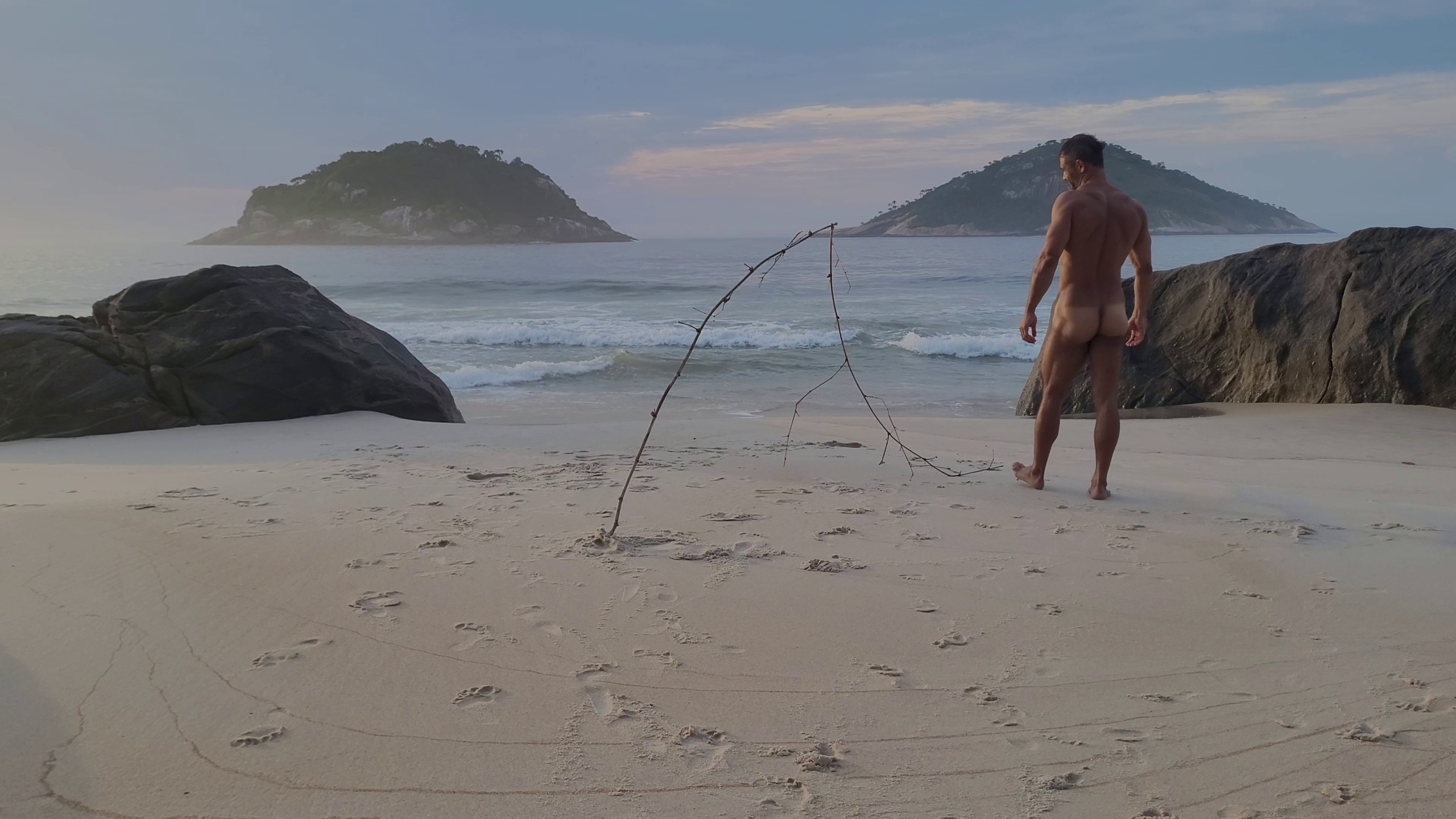
In Proposition No. 16 , created on the naturist beach of Abricó (Rio de Janeiro), the artist undresses his own body and returns himself to the oceanic landscape. This gesture echoes a previous action described in “Shelters on the Rocks / Haikus in the Ocean” : in the preceding work, bare branches had been returned to nature as temporary shelters among sea rocks – an ephemeral offering of organic matter to the environment. Now, it is the artist’s naked body that settles in the same landscape, becoming a shelter for himself and part of the natural scene. There is a spiritual symmetry between wood and skin, between branch and limb, as if the human organism recognized itself as made of the same material as the world: carbon, salt, desire . The artist—naked like a branch exposed to the sun—proposes a return to the basics, in humble communion with the wind and the waves. The bilingual inscription on the Abricó sign reads: “From this point you will find naked people… Beyond this point you will encounter nude bathers .” This formal signage [41†] marks the dividing line between the textile (clothed) world and the naturist sanctuary. Crossing this threshold is both a physical and poetic act of de-disciplining the body: abandoning the armor of fabric and social roles, and reassuming a primordial vulnerability. In exchange, the “shelter” offered is intangible: a temporary community of free bodies, a sense of communal peace in “being naked together” that harks back to the infancy of humanity and, paradoxically, anticipates a post-human future.

(Full uncut frontal nudity video)
Abricó (Rio de Janeiro)
Genealogy of the Nude and Eroticism
Undressing in public is an act laden with historical and philosophical layers. In Ancient Greece, male nudity in gymnasiums celebrated the ideal of the divine body; while medieval Judeo-Christian morality clothed the flesh in sin and modesty, enclosing nudity in taboo and shame. Each era produces its own regime of body visibility. Michel Foucault noted how, from the 17th century onwards, Western societies inaugurated disciplinary mechanisms that manufacture docile bodies to serve the productive order [1] . Public nudity—because it does not serve productivity and challenges decorum—became indecent, except in isolated spaces (the bathroom, the brothel, the asylum). Modern biopower , in Foucault’s words, regulates populations “making live and letting die” [2] , including normalizing sexuality and bodily exhibitionism. With the advent of modern naturism, however, we see a counter-current: the Freikörperkultur (FKK) movement in Germany, since the end of the 19th century, proposed a “return to nature” through non-eroticized social nudity . The culture of the free body de-eroticized the naked body , advocating that nudity in itself is not sexually provocative – it is civilization that has taught us to see it that way [3] . This revolutionary (and utopian) perspective understood collective nudity as hygiene, freedom and equality: naked men, women and children, sharing beaches and parks without the mediation of shame, as an integral part of the environment . Under this prism, nudity returns to a cosmological state , that is, inserted into the natural order of the cosmos, free from the stigma of “obscene”.
However, eroticism is still present, albeit transfigured. If naturism seeks to desexualize nudity to reveal its social purity, thinkers like Georges Bataille see eroticism precisely as the transgressive force that arises from prohibition. Bataille defined eroticism as “an affirmation of life, even in death” [4] , a creative energy that springs from the friction between the forbidden and its transgression . Unlike mere animal sexuality, human eroticism inhabits the domain of taboo and its overcoming [5] . By undressing in a public place (even if authorized), the artist performs a slight ritual transgression: there are rules and codes in the naturist environment, but their voluntary nudity reactivates, on a minimal scale, that dynamic described by Bataille – desire flows precisely where there was a limit. The naked body in Abricó is simultaneously de-eroticized (since it shares a community context without direct sexual connotation) and re-eroticized by the artistic gaze that inserts it into a genealogy of bodily and queer performances. Here, Judith Butler would be remembered: gender and decorum are regulated performances, and the gesture of undressing in public (even more so for a gay man or queer person) takes on the contours of an insurgent performance , challenging the heteronormative norm that dictates which bodies “can” show themselves and which must remain veiled. In other words, the act subverts the idea that pleasure and the exposure of the body are vulgar or profane; instead, it reclaims the naked body as a living philosophical text , open to new readings.
Proposition No. 16 was recorded on full, uncut video.
Digital Biopower and Moralizing Algorithms
If discipline once operated in schools, barracks, and prisons to control bodies, today it extends to digital platforms . In an era where existence is measured by online visibility, moralizing algorithms have become the new guardians of public decency. On social networks like Instagram and Facebook, sophisticated AIs have been trained to detect “dangerous body parts” – female nipples , buttocks, genitals – and summarily censor them [6] . The result is a true algorithmic censorship of nudity : artistic or documentary photos are removed if they show a female breast, while similar representations of male torsos remain unpunished [7] . This automated morality carries gender and sexuality biases: a journalistic investigation revealed that artificial intelligence classifies images of female bodies as more sexually suggestive than those of men [8] . The puritanism inscribed in the code reflects and reinforces old patriarchal patterns – what Butler would identify as the “ normative gaze ” reincarnated in a line of code.
The consequences for artists and body dissidents are severe. In recent years, there has been a proliferation of cases of photographers, performers, and activists having their accounts deleted or shadowbanned for posting works of nudity or non-pornographic eroticism [9] . The platform rarely distinguishes context : a nipple exposed as a form of political protest or artistic expression receives the same veto as explicit pornographic content. As artist Emma Shapiro, whose professional Instagram was shadowbanned, denounced, “Sex is not the subject of my art; I only use a naked body. I have always felt very offended by my body being sexualized without my intention” [10] . This forceful statement exposes the core of the problem: the algorithm (trained on market sensibilities) unilaterally sexualizes the naked body, ignoring intention and context. The machine reads exposed skin as a moral danger, transforming into “vulgarity” what, in the artist’s view, was cosmological pleasure or cultural critique.
We can interpret this digital surveillance as a diffuse extension of Foucault’s biopower: a global Panopticon that scrutinizes selfies and video frames in search of deviations from the community norm. Discipline now operates at the level of pixels and hashtags, “manufacturing” a docile digital subject who self-censors their body before the algorithm punishes them. This panorama justifies the provocation of the trans philosopher Paul B. Preciado when he says that we live in a pharmacopornographic regime : on the one hand, the pharmaceutical industry chemically controls bodies; on the other, the pornographic (and anti-pornographic) industry defines what can or cannot be seen. Under such a regime, pleasure and images are closely monitored commodities. However, as Preciado argues, “the best antidote to mainstream pornography is not censorship, but rather the production of alternative representations of sexuality, made from perspectives that diverge from the normative gaze” [11] . In other words, the answer lies not in silencing visual desire, but in symbolically hacking it – creating new bodily aesthetics, new erotic imaginaries, capable of circumventing and challenging the prevailing norms.
Art as Symbolic Hacking
Faced with the automated pruning of the senses, artists and activists have responded with cunning and irony, transforming censorship into creative raw material. A striking example is the “Don’t Delete Art” campaign , which exposes the paradoxes of Instagram’s policies. Photographer Savannah Spirit, after seeing a series of pin-up self-portraits deleted, developed an aesthetic strategy to deceive the algorithm: she began covering her naked body with the filtered shadows of blinds and lace , creating a veil of light and darkness over her skin [12] . These images, although explicitly nude, confuse the computer vision – the stripes and patterns induce the AI to err, making it “lose” the nudity it so desperately seeks to censor. Spirit reports that this erotic camouflage tactic not only circumvented censorship but added a new conceptual layer to her work, making it “better” in a certain sense [12] . Here is symbolic hacking : the artist subverts the moral filters of the system by using its own rules as an aesthetic element. Similarly, the artist Spencer Tunick – famous for photographing naked crowds in urban spaces – had his account banned, but continues to orchestrate his happenings on a global scale, disseminating the images through alternative channels. The message is clear: the desire to make the common body visible (naked, imperfect, free) is more inventive than the codes that attempt to suppress it.
Other performative actions deal with censorship in a playful way. In 2014, artist Micol Hebron created the digital sticker “ Male Nipple ” – basically, cutouts of white male nipples, made available so that anyone could cover female nipples in their photos and thus escape automatic banning [13] . Hebron’s serious joke highlighted the absurdity of the sexist rule: if the male nipple is allowed, then simply sticking it over the woman’s is enough to “purify” the image. Emma Shapiro launched “ Exposure Therapy ” in 2017, distributing physical stickers with photos of female nipples to be pasted around the world – on lampposts, trash cans, beaches – accompanied by another sticker declaring “Nudity is not pornography” [13] . These guerrilla gestures spread through urban space what virtual space suppresses, claiming the right to body representation without immediate sexualization or shame. Here we have direct echoes of the FKK movement from a century ago: the “Nudity≠Porn” stickers pasted in public places revive the notion that the naked body can exist outside the pornographic circuit and the objectifying gaze. It is performance art occupying the place of a pedagogy of the gaze – teaching, through humor and scandal, that there are different ways of seeing nudity.
Technology itself can also be creatively appropriated. “Moralizing” algorithms can be re-hacked for subversive purposes, in a kind of digital shamanism. There are already queer art projects in augmented reality that virtually insert invisible genitalia and nipples onto classical sculptures in museums (a ghostly revenge against the fig leaves added centuries ago). Other artists work with glitches, distorting censored images until they become abstract patterns – beautiful and undecipherable to censoring AIs. These practices operate on the threshold of what is admissible, expanding the system’s loopholes. As Donna Haraway said , we need to “inhabit the boundaries” creatively: in her Cyborg Manifesto , Haraway proposes hybrid figures and ironies to crack oppressive dichotomies. Here, we can imagine the naturist cyborg – half organic body in communion with the earth, half digital presence navigating the filters of the network. The nude artist on the beach, documented by cameras and disseminated online, becomes a liminal being: his body is real and earthly (covered in sand, interacting with the bare branches around him), but it is also algorithmically given , risking detection and deletion. By assuming this position, he acts as a symbolic hacker of the social machine: he tests the limits of what is permitted and, in doing so, exposes the ideology behind the algorithm. After all, as theorist Donna Haraway observed , “the boundaries are either far above or far below the dominant current ,” and it is within them that new plots can be woven – in this case, plots of sensory freedom.
Cosmological Pleasure versus Vulgarity
At the heart of this discussion is the struggle to redefine pleasure . Historically, authoritarian regimes – from the religious Inquisition to Instagram filters – label certain expressions of pleasure (especially those linked to the body and non-reproductive sexuality) as vulgar , base , unworthy of the public sphere. Such labeling serves a politics of fear: it separates the cosmos (order, the elevated) from chaos (the carnal, the Dionysian), as if pleasure and spirituality were incompatible. The artist’s poetic-critical project at Praia do Abricó goes against this: it reclaims sensory pleasure – of being naked in the sun, of feeling one with the breeze and the salt water – as a cosmological gesture . That is, as part of the order of the universe, as legitimate and necessary as the act of breathing or contemplating the stars. This reintegration echoes ancient traditions and marginalized knowledge. Pagan cultures venerated sexual ecstasy as a portal to the divine; Tantric mystics viewed erotic union as a microcosm of cosmic creation. Even in Bataille’s theories, the erotic climax borders on the experience of the sacred, because in orgasm (the “little death” ) the being breaks its individuality and communes with something greater, unheard of.
In the contemporary context, Paul B. Preciado and post-porn thinkers uphold a similar idea: to disarm normative power, it is necessary to cosmologize pleasure, to remove it from the ghetto of commercial pornography and spread it throughout everyday life, through the languages of art, intimacy, and conviviality. This implies affirming that seeing a naked body, or experiencing pleasure, or appreciating erotic beauty, is not in itself indecent – on the contrary, it can be luminous and enlightening . “Reinscribing pleasure as a cosmological gesture” means returning it to the circuit of the world’s vital energies, treating it as embodied knowledge. In a 1979 essay, Michel Foucault already pointed out that the challenge was to escape the double trap of repression and the scientistic discourse on sex, in order to invent “new forms of pleasure” and freedom. Queer and feminist struggles have done exactly that: from LGBTQ+ pride (which transforms shame into public celebration) to dissident sex practices and camp aesthetics, what was once labeled dirty or laughable can gain the status of art, politics, and ritual. Judith Butler wrote about the power of bodily alliances in protest – bodies together in the streets, sometimes semi-nude or cross-dressing, enacting choreographies of resistance. These performative alliances demonstrate that bodies matter , and that shared vulnerability is a source of power. In the act of exposing himself naked in Abricó, knowing that such an image might not “live” on Instagram without retaliation, the artist embodies this powerful vulnerability. He makes himself an offering : just as the bare branches became poetic shelter, his naked body becomes a silent manifesto.
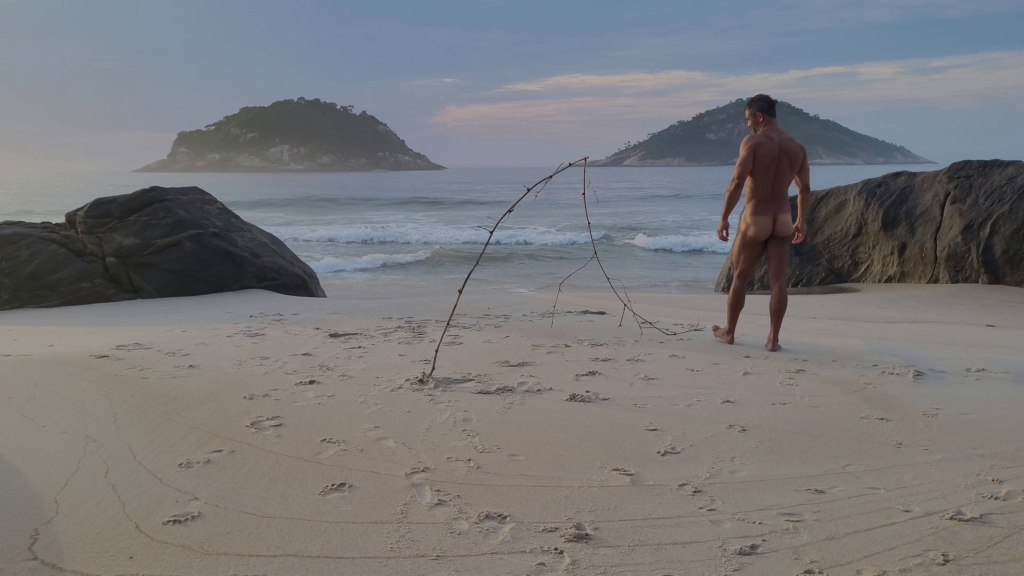
We can therefore read Proposition 16 as an incarnate haiku . The dry branches, gathered from the sea and assembled as shelter, rhyme with the solitary, naked human figure among the stones. Both are remnants and promises : raw matter and living desire. The performance suggests that nature and desire reflect each other , pointing to a non-fragmented worldview. Pleasure here is not vulgarity to be censored, but rather a kind of cosmic glue connecting disparate elements – human and non-human, online and offline, past and future. Facing the sea and under the open sky, the artist reconnects to a greater order that escapes the puritanical grammar of algorithms. He inscribes his pleasure (of existing without constraints, of defying surveillance) in the great poem of nature, like a white fire on the brain , burning but not consuming, illuminating new possibilities of being.
Ultimately, the critical-theoretical-poetic text before us is also an act of cosmological resistance. It makes use of quotations and concepts (Bataille, Foucault, Haraway, Butler, Preciado) in the same way that the artist uses branches and his own flesh: to build temporary shelters of meaning upon the slippery rocks of contemporaneity. It is a shelter made of naked words, seeking to protect – even if only for a moment – the flame of free pleasure , so that it does not go out under the cold winds of digital censorship. Each reference woven here is a beam in this shelter: Bataille bringing the element of transgression-creation; Foucault, the power structure we need to circumvent; Butler and Preciado, the strategies of queer re-existence; Haraway, the vision of a future where we can be sensual cyborgs , in harmony with all our parts. And right there beside us, silently, the bare branches observe. The sea continues to recite its haikus on the waves. The struggle continues, in every upload and every sunny morning: do not delete the art, do not prohibit ecstasy . For, as a sticker pasted on a New York lamppost proclaimed: Don’t delete art . And we could add: do not delete the body. It is our first and last refuge.
References: Georges Bataille; Michel Foucault; Donna Haraway; Judith Butler; Paul B. Preciado; FKK (Freikörperkultur) Movement; Naturism on Abricó Beach; “Don’t Delete Art” campaign and cases of digital censorship of nudity; Body art and contemporary queer performance (Spencer Tunick, Savannah Spirit, Emma Shapiro, Micol Hebron, among others). [4] [3] [8] [10] [11]
[1] Docile Bodies – Michel Foucault | Crooked Columns
https://colunastortas.com.br/corpos-doceis
[2] On the biopolitics of Giorgio Agamben: between Foucault and Arendt
https://www.redalyc.org/journal/5766/576664910014/html
[3] Naturism in Germany – Wikipedia, the free encyclopedia
https://pt.wikipedia.org/wiki/Naturismo_na_Alemanha
[4] Microsoft Word – final dissertation.docx
https://repositorio.unb.br/bitstream/10482/20452/1/2016_LuisFl%C3%A1vioAlmeidaLuz.pdf
[5] TOP 25 QUOTES BY GEORGES BATAILLE (of 90) | AZ Quotes
https://www.azquotes.com/author/1033-Georges_Bataille
[6] No, Facebook does not censor naked people: the puritan is its algorithm (and that is not bad)
[7] [8] [9] [10] [12] [13] In protest, activists tell Meta/Instagram to stop deleting images about art | Dasartes
[11] SciELO Brazil – Feminist debates on heteronormative pornography: aesthetics and ideologies of sexualization Feminist debates on heteronormative pornography: aesthetics and ideologies of sexualization
Deixe um comentário