The concept of the Shiva Lingam traces back to ancient Hindu scriptures and myths. Early Vedic references are indirect: no “lingam” appears in the Rigveda, but the Atharva Veda has hymns praising a Skambha (pillar) that symbolizes the eternal Brahman – a prototype for Shiva’s cosmic pillar[1]. The Shvetāśvatara Upaniṣad (an early post-Vedic scripture) explicitly states that “Shiva has no liṅga or mark, meaning he is transcendent, beyond any characteristic.” In other words the liṅga is not Shiva’s body but the “sign” of the imperishable Purusha/Brahman[2][3].
Later Puranas elaborate myths about the Lingam. For example, the Shiva Purāṇa describes Shiva appearing as an infinite column of fire (Liṅgōdbhava), a shining pillar whose ends cannot be found by Brahmā or Viṣṇu[4][5]. In these texts the Lingam is portrayed as niśkāla (formless) Shiva – a symbol of the absolute Brahmarūpa[4][6]. The Liṅga Purāṇa even says the Lingam is the combined image of Śakti (the Yoni base) and Śiva (the liṅga itself) – a union of creative energies[6]. In sum, scriptural sources emphasize that the Lingam represents Shiva’s formless, infinite nature rather than a literal “body part.”
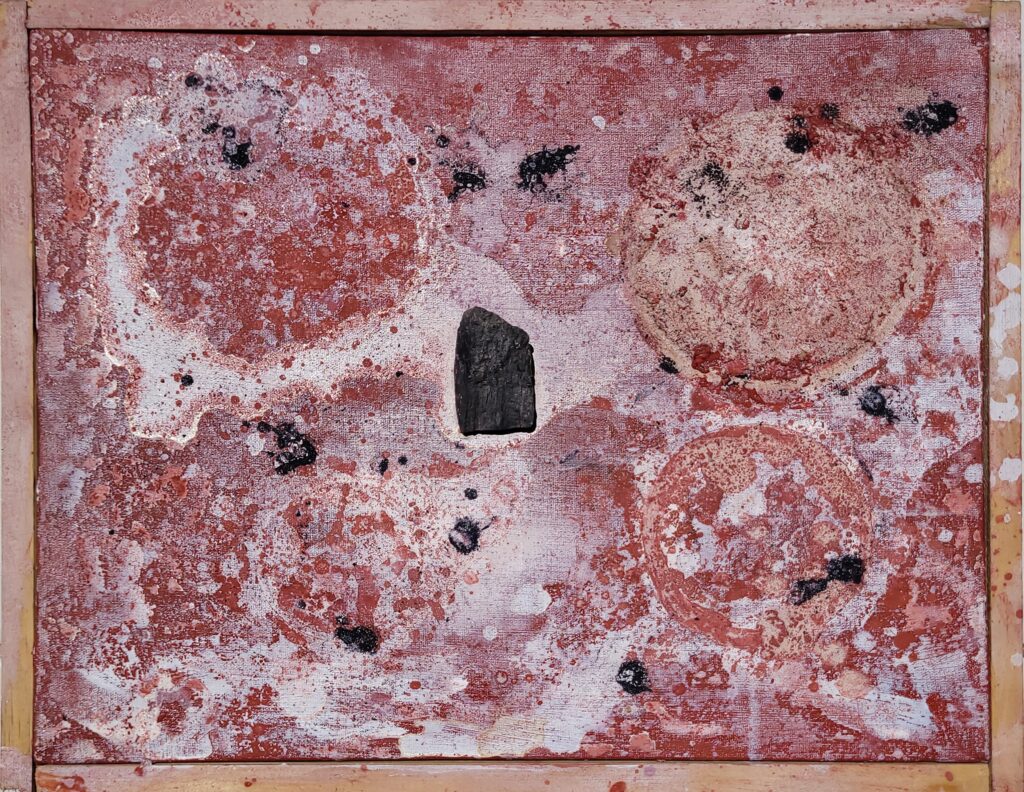
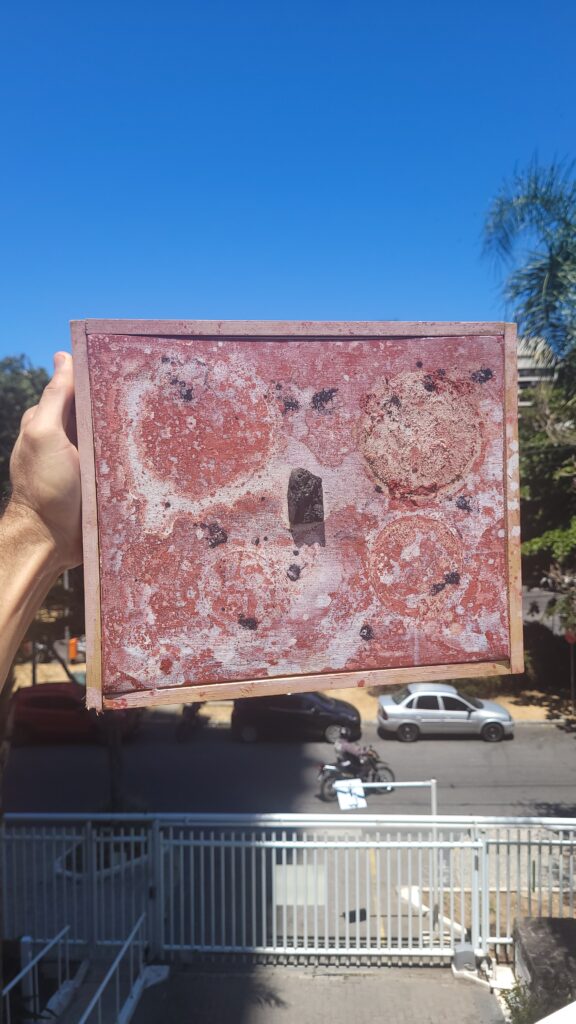
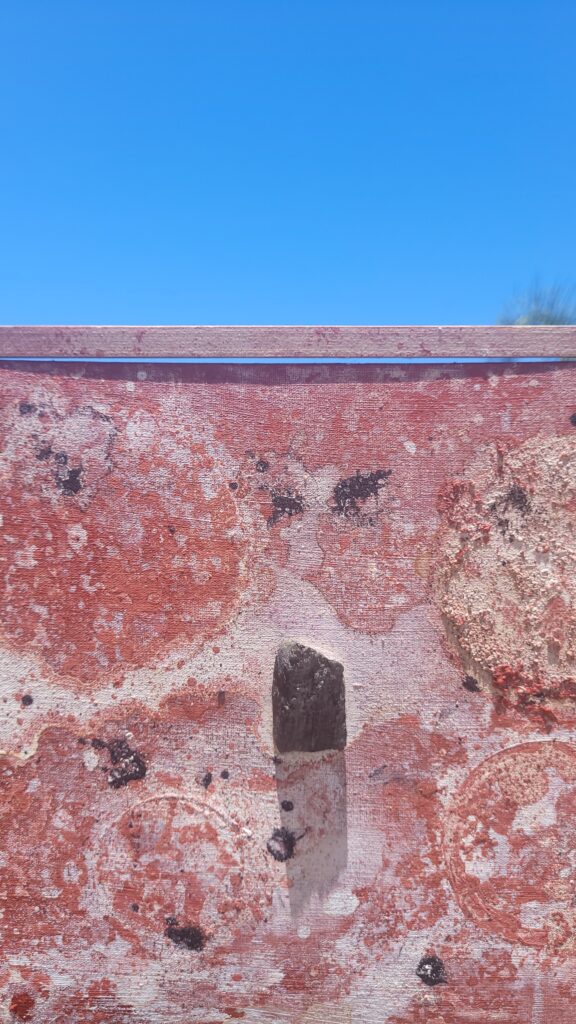
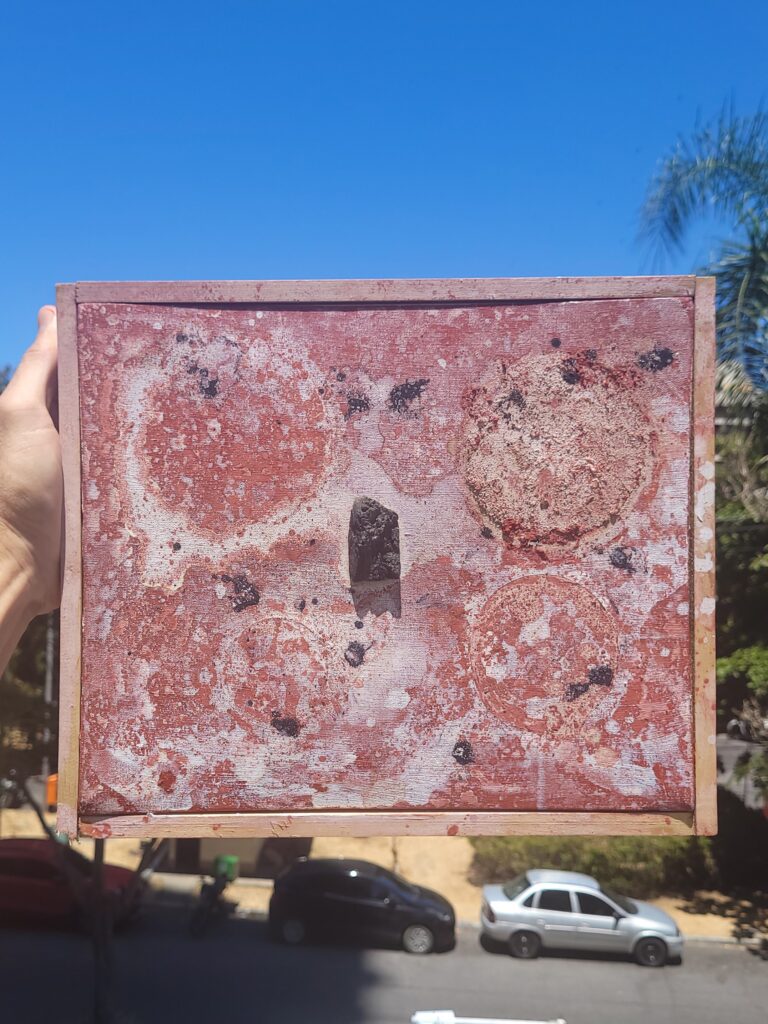
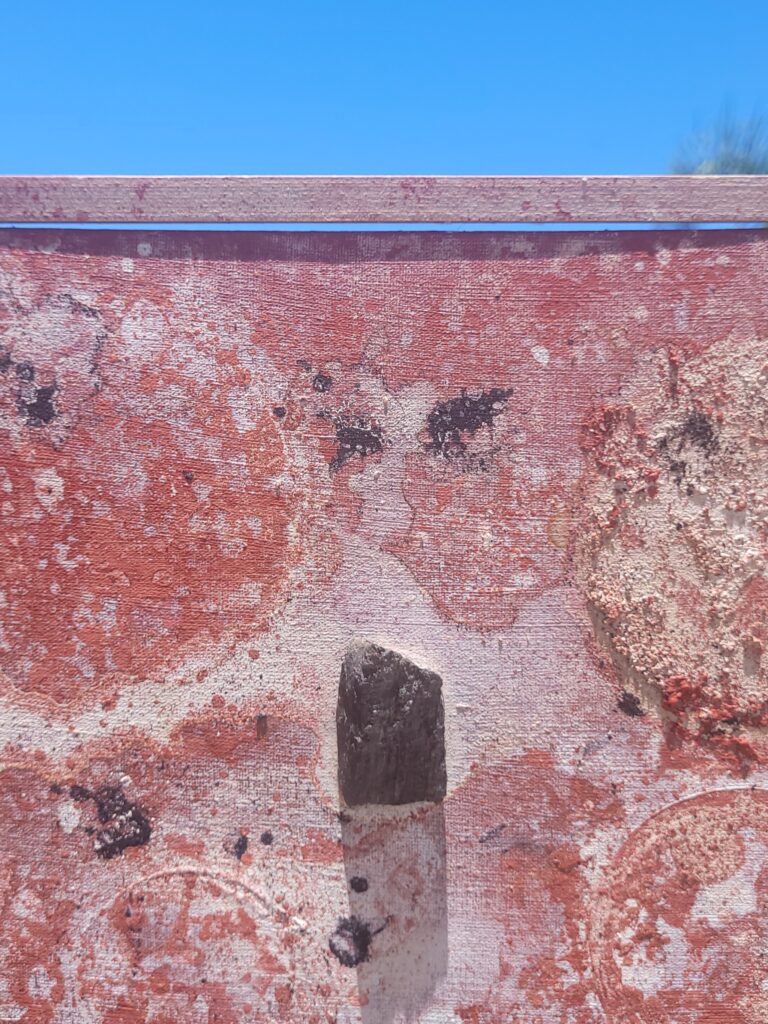
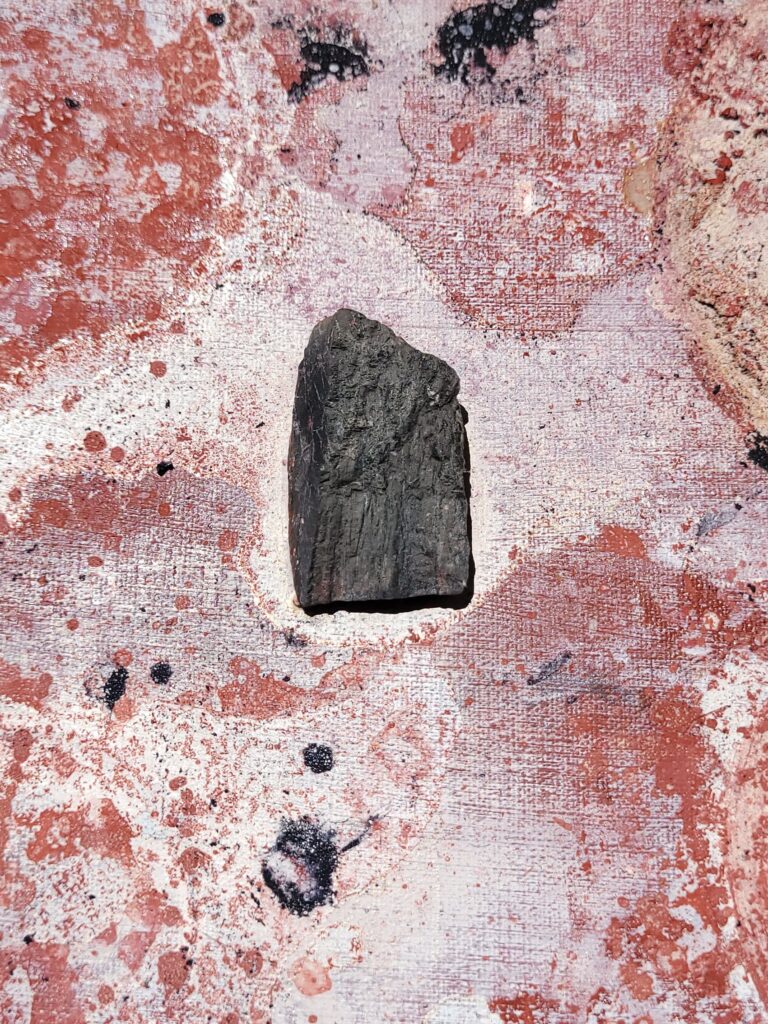
10.5 × 32 × 3 cm
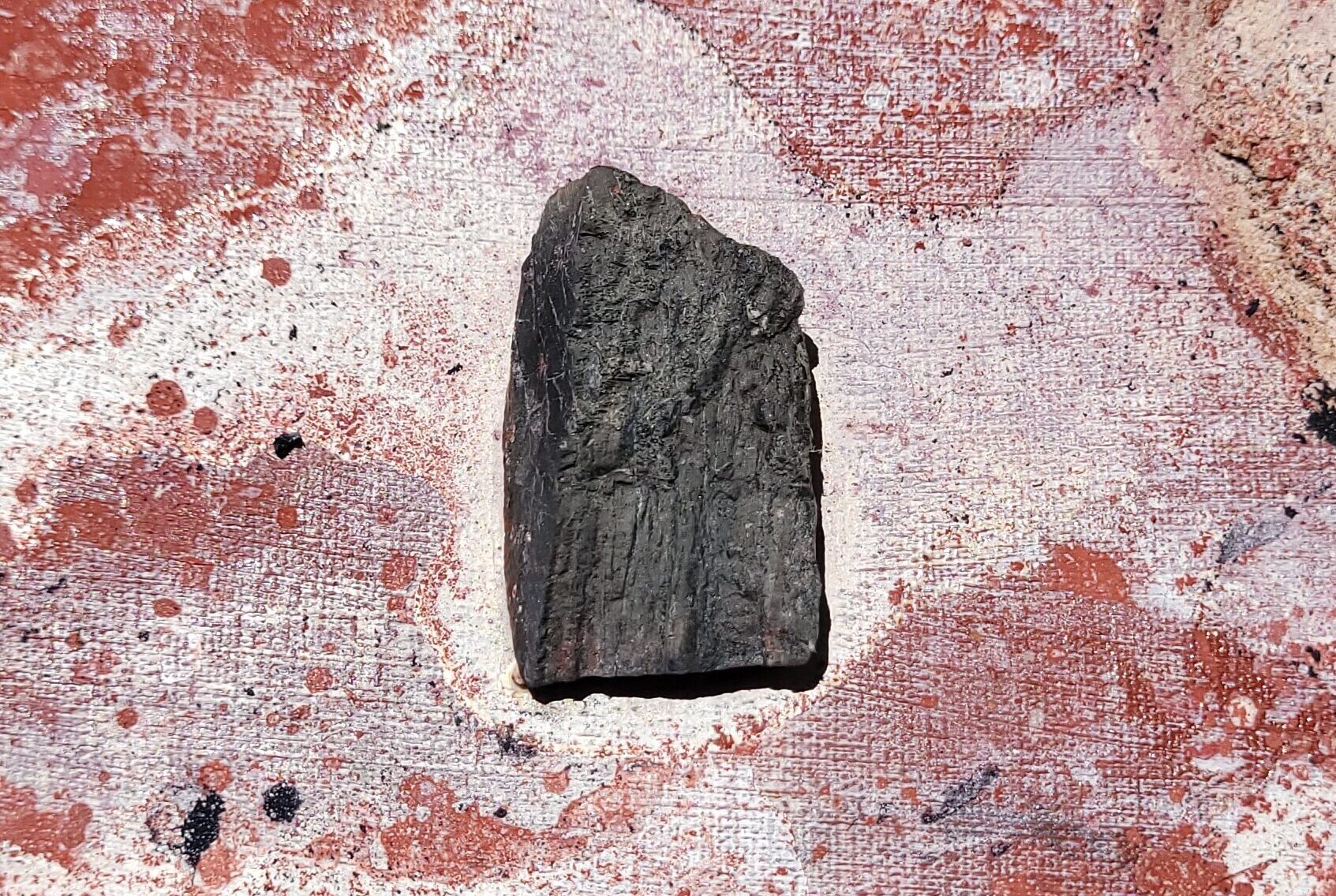
Acrylic paint, oil paint, dew, and fragments of Black Rock igneous/vulcanic stone
Rodrigo Garcia Dutra
The Lingam–Yoni iconography is rich with layers of meaning. In its simplest form the Lingam is a smooth, cylindrical pillar set in a round base (yoni). It is generative and infinite: symbolizing creation, preservation and dissolution in the cyclical universe. As an “axis mundi” or cosmic pillar, it represents Shiva’s omnipresence. One tradition explains the geometry: the base and pillar often have multiple facets (square, octagonal, circular) corresponding to Brahma, Viṣṇu and Rudra – the three functions of creation, preservation and destruction[7]. The circle in particular “has no beginning or end” and thus evokes the infinite and the supreme reality[8].
Devotees interpret the Lingam as liṅga, meaning “sign” or “symbol” of the formless Absolute. It is aniconic: Shiva is beyond form, gender and image[2][6]. The Lingam stands for the indescribable Brahman, the invisible cosmic energy. As one scholar puts it, in Hindu symbolism the Lingam is “considered a symbol that refers to the Infinite or Absolute Reality”[9]. It embodies the union of Śiva (consciousness) and Śakti (energy): raised from the Yoni, it is the source of life and devotion. Thus, although superficially pillar-like, the Lingam is meant to convey the ultimate mystery of the universe – unity of microcosm and macrocosm, male and female principles, the seen and unseen.

A Shiva Lingam in a South Indian temple: the cylindrical form represents Śiva’s infinite, formless essence.
A long-running debate concerns the phallic interpretation of the Lingam. Some early colonial and Orientalist writers (and a few modern critics) portrayed the Lingam simply as “phallus worship” or a fertility cult. However, Hindu scholars and devotees strongly dispute this narrow view. They emphasize that for practitioners the Lingam is not a sexual organ, but a sacred symbol of cosmic energy. As one commentator notes, Western accounts that call the Lingam a “Shiva penis” reflect colonial stereotypes, not Hindu belief[10][11]. In the Puranic legend the column of light that Brahma and Viṣṇu failed to traverse became the Lingam – a fiery, formless pillar, not a literal phallus[12][13].
Modern scholars likewise point out that indigenous texts treat the Lingam in spiritual terms. The Shiva Purana and Liṅga Purāṇa explicitly distinguish the Niṣkala liṅga (formless) from ordinary deity statues, and never call it an organ[14]. In fact, early archaeological finds (e.g. the Gudimallam Lingam from ~100 BCE) were anatomically phallic but were interpreted by scholars as symbols of Urdhva-retas (ascetic energy) and Shiva’s yogic power, not mere eroticism[15][16]. A leading historian, Stella Kramrisch, emphasized that the Lingam’s iconography “should not be mistaken for fertility or eroticism” but understood in context of spiritual discipline[17]. Today the consensus is that the Lingam is primarily a religious emblem of Shiva’s all-pervading spirit, and that reductive “phallic” labels are both disrespectful and ethnocentric[11][12].
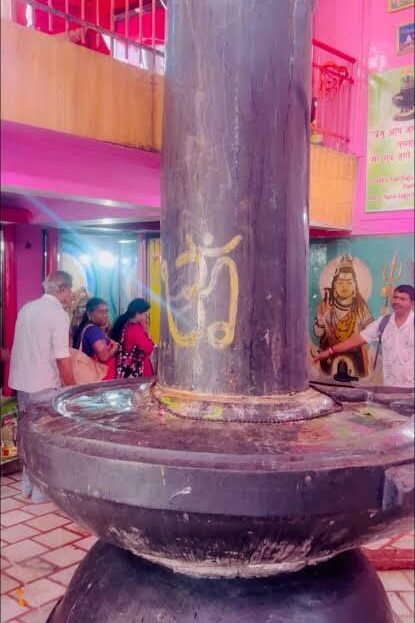
Major temples: Shiva Lingams are housed in thousands of temples across India and beyond. The most famous Jyotirlinga shrines include Somnath (Gujarat), Kashi Vishwanath (Varanasi) and Kedarnath (Himachal/Uttarakhand)[18][19][20]. For example, Somnath Temple (Veraval) is “held in reverence throughout India” and was rebuilt 16 times after historic destructions[18]. Kashi Vishwanath in Varanasi is perhaps the holiest Shiva temple – situated on the Ganges and regarded as the supreme pilgrimage site[19]. Kedarnath, high in the Himalayas, is the northernmost Jyotirlinga and part of the Char Dham pilgrimage circuit[20]. Another celebrated site is the Amarnath Cave in Kashmir, where an ice Lingam naturally forms each summer. This stalagmitic Shiva Lingam waxes and wanes with the lunar cycle[21][22], symbolizing Shiva’s immortality.
- Temples & shrines: Many local shrines (e.g. small village lingams, cave lingams, mountain pillars) also exist. Tantric and folk traditions often venerate natural lingams (baḍī-liṅga) like stones and hillocks. Some sects (Kaulas, Naths, Śaiva Siddhāntins) emphasize Lingam meditation and worship as a path to realization.
- Abhiṣeka (ritual bath): A central practice is the Abhiṣeka, the ceremonial anointment of the Lingam. Devotees pour water, milk, yogurt, honey, ghee (clarified butter) and other auspicious substances over the stone pillar[23]. These liquids flow over the Lingam into the yoni base, symbolizing purification and divine grace. Priest and worshippers chant hymns as offerings of flowers, fruits, rice and leaves are made at its feet[23]. Abhiṣeka is believed to imbue the Lingam with spiritual potency and cleanse the devotee’s mind.
- Regional variations: Ritual details vary by region. In Tamil Nadu, many Lingams are polished black granite with inscriptions (e.g. Gupta Temple, Madurai). In the Himalayas (e.g. Amarnath), natural stalagmites suffice. In some tribal and Tantric rites, a yantra or geometric base may be used instead of a yoni. But universally, the Lingam is seen as the living heart of the temple.
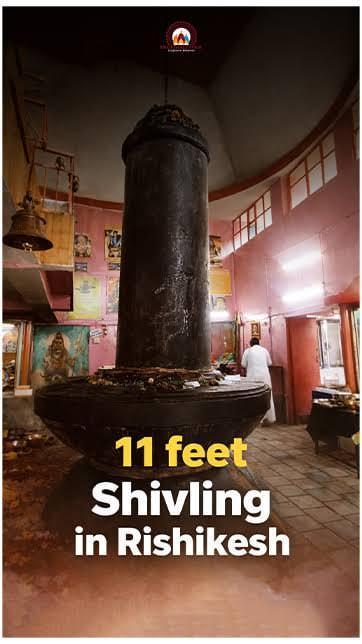
- Śaiva lineages: Various Śaiva lineages (temple priests, monastic orders and tantric lineages) carry on Lingam worship. For instance, the Nātha-siddha (Yogic) tradition venerates the Swayambhu Lingam as the body of Lord Śiva in meditation. Even new temples like the modern Śakti Śachchā (Sachcha) sect in Rishikesh emphasize ancient rites. The Shri Sachcha Akhileshwar Mahadev Mandir in Tapovan, Rishikesh, houses a massive Shiva Lingam – reputedly 11 feet tall and ~7 tons in weight[24] – as a contemporary homage to the primordial pillar.
Beyond theology, the Lingam inspires poetic contemplation. It is often described as the “formless form” – a silent pillar that conveys both emptiness and boundless energy. Philosophers liken the Lingam to śūnya (the void) and to brāhmaṇ (ultimate reality). As one scholar writes, “the Shiva Lingam…represents Infinite Reality”[25]. The unending circle of its cross-section reminds devotees of ākāśa (limitless space) and the cyclic nature of existence[8].
In devotional poetry, Shiva’s aniconic presence in the Lingam is a source of awe: it is the point where heaven meets earth, the cosmic pillar upholding the universe. Worshippers see in its austere shape the paradox of emptiness “full” of divine power. Tulsi Dāsa’s songs and modern bhajans celebrate how the Lingam “lights up the temple” as Śiva’s formless light. In meditation, the Lingam becomes a dyānaliṅga (object of concentration), focusing the mind on the One beyond all forms.
Ultimately the Shiva Lingam stands as the Adi-Prakṛti, the prime matter, and the gateway to Māyā (illusion) being transcended. It invites the seeker to experience the cosmic dance of Śiva–Śakti within the still point of the cave. In every drop of milk that splashes over its basalt curve and in every mantra chanting at its base, devotees glimpse the silent mystery of Shiva – the eternal “pillar” or light that neither begins nor ends.
Sources: Academic sources and religious texts (Upaniṣads, Purāṇas) and contemporary research were consulted[26][6][11][19][23][25], among others, to support this study.
[1] [2] [15] [16] [17] [23] [26] Lingam – Wikipedia
https://en.wikipedia.org/wiki/Lingam
[3] [5] [6] [12] [13] [14] Why is Lord Shiva worshipped in Linga Form?
[4] Shiva lingam and its meaning – The Medha Journal
[7] [8] [9] [25] Understanding Shiva Lingam against the backdrop of Cosmology
[10] Western reading of Shivalingam as phallic symbol is incorrect. For Hindus, Shiva is formless
[11] ‘Not a controversy, it’s a contemporary issue’
[18] [19] [20] Jyotirlinga – Wikipedia
https://en.wikipedia.org/wiki/Jyotirlinga
[21] The complete story of Amarnath Cave Temple: a mystical natural shivling formed from Himalayan ice
[22] Amarnath Shivlingam: Amarnath Cave’s Ice Shiva Lingam
[24] Shri Saccha Akhileshwar Mahadev Temple Rishikesh (Timings, History, Entry Fee, Images, Aarti, Location & Phone) – Haridwar Rishikesh Tourism
https://haridwarrishikeshtourism.in/shri-saccha-akhileshwar-mahadev-temple-rishikesh
Leave a Reply